

Get in touch
Close

Contacts

1108, The Orion, Sarkhej – Gandhinagar Hwy, near Shree Balaji Temple, Ahmedabad, Gujarat 382481.

+91 90169 88361
+1 (857) 314-0901

contact@mpiricsoftware.com

Kernel Security and Hardening

Linux Development

EngineeringSafe Kernel Execution Paths

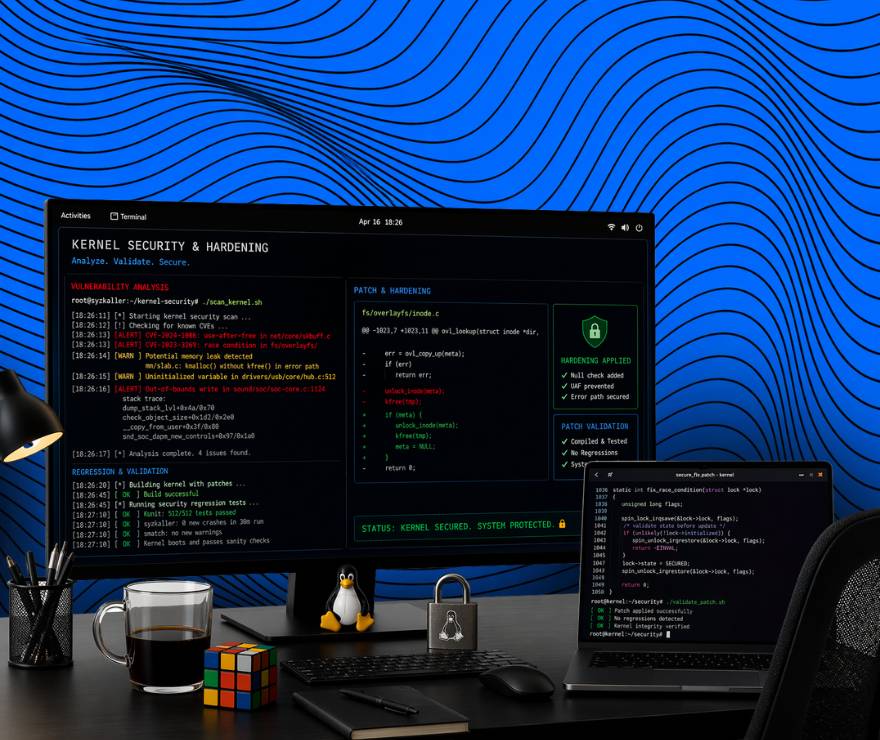
Mpiric approaches Linux kernel security as a problem of correctness, control, and deep system understanding rather than surface-level protection. Our work operates inside kernel execution paths where memory handling, concurrency, and subsystem interactions define the system’s security posture. 

We analyze how vulnerabilities emerge through race conditions, improper validations, and unsafe memory operations, and then reproduce these issues in controlled environments to understand their full impact. As a Linux development company, we support systems where kernel integrity is critical, including infrastructure platforms, embedded systems, and security-sensitive environments. 

By combining vulnerability research, patch validation, and execution path hardening, we ensure that kernel behavior remains predictable, resistant to exploitation, and stable under real-world workloads and evolving threat scenarios.

Kernel levelsecurity and hardening capabilities

From initial patch development through mailing list submission and maintainer review cycles to final merge, our linux kernel upstream services cover the full contribution lifecycle. Here’s what we engage on.

01.

Kernel Security Research

In-depth research into kernel behavior to identify potential vulnerabilities, unsafe patterns, and security risks within subsystem implementations.
02.
Vulnerability Analysis & Reproduction
Systematic analysis and controlled reproduction of vulnerabilities to understand root causes and validate exploit conditions within kernel paths.
03.
Patch Validation & Regression Checking
Verification of security patches to ensure correctness, prevent regressions, and maintain stability across kernel versions and workloads.
04.
Kernel Path Hardening
Strengthening of vulnerable or high-risk execution paths to reduce attack surface and improve resilience against exploit scenarios.
05.
Memory & Concurrency Issue Analysis
Detection and resolution of memory leaks, race conditions, and synchronization issues that can lead to instability or security flaws.
06.
Correctness & Safety Validation
Ensuring kernel logic behaves as intended under edge conditions, eliminating undefined behavior and improving system reliability.
0 %
Faster Vulnerability Root Cause Identification
Structured analysis and controlled reproduction enable rapid identification of kernel vulnerability sources and exploit paths.
0 %
Reduction in Security Regression Risks
Rigorous patch validation and regression testing ensure security fixes do not introduce new instability or vulnerabilities.
0 X
Improvement in Kernel Path Resilience
Hardening of critical execution paths significantly reduces exploitability across memory and concurrency-related attack surfaces.

IndustriesIndustries We Serve

Semiconductor & Hardware Vendors
SoC vendors, chip manufacturers, and hardware platform companies need their hardware supported in the mainline kernel, not maintained in a private fork that costs engineering time with every kernel release. We upstream the driver and platform support.
Embedded Systems & IoT
Embedded Linux products ship with out-of-tree patches more often than they should. We upstream the platform enablement, driver support, and hardware-specific fixes that embedded product teams carry, reducing the long-term firmware maintenance cost significantly.
Automotive & Aerospace
Safety-relevant Linux deployments in automotive and aerospace platforms have strict requirements around kernel provenance and traceability.
Cloud & Hyperscale Infrastructure
Cloud providers and hyperscale operators running Linux at massive scale have both the incentive and the obligation to contribute upstream.
Defence & High-Integrity Systems
Security-critical Linux deployments benefit from CVE fixes and hardening contributions being upstream, where they’re part of every subsequent kernel release rather than private patches.
Telecommunications
Telco operators and equipment vendors running Linux in their network infrastructure benefit directly from upstream fixes and improvements to the networking subsystem, packet processing stack, and real-time capabilities. We contribute at this level.
TECHNOLOGY
STACK

WP Forms

Polylang

Loco

WPML

WP Rocket

W3 Total
Cache

MailChimp

WhyWhy Mpiric for Linux Kernel Upstream Solutions

Mpiric approaches Linux kernel security by focusing on how vulnerabilities originate within execution paths rather than treating security as an external layer. Our work operates directly within kernel internals, including memory handling, concurrency control, and subsystem interactions, where most critical vulnerabilities emerge. By reproducing real exploit scenarios and analyzing execution behavior, we ensure that issues are understood at their root rather than addressed superficially.

Our approach prioritizes correctness, stability, and long-term resilience. As a Linux development company aligned with practices followed across the Linux Foundation ecosystem, we ensure that security fixes integrate cleanly, avoid regressions, and remain effective as kernel versions, workloads, and threat landscapes evolve over time.

01
Exploit-Level Understanding

Our engineers understand what subsystem maintainers look for, how the mailing list review process works, and what makes the difference between a patch that gets merged and one that gets ignored.

02
Upstream-First Thinking
Every patch we write is structured with mainline acceptance in mind from the first line not refactored into shape at the end.
03
Systematic Reduction of Out-of-Tree Burden
We don’t just submit individual patches. We help you build a strategy to get the right code upstream and reduce that maintenance overhead systematically over time.
04
Full Lifecycle Ownership

We manage the full submission process, cover letter, review responses, revised versions, maintainer follow-up, until the patch is confirmed merged into the target kernel tree.

05
Global Team, Continuous Kernel Tracking
With engineers across India, USA, and UK, we track kernel development continuously, merge windows, subsystem changes, API shifts, stable branch releases.

Carrying Out-of-Tree Patches, Belong in Mainline? Let's Fix That.

Whether you’re a hardware vendor whose driver has never made it into the official kernel, an organisation managing a growing backlog of out-of-tree fixes, or an engineering team that needs upstream linux kernel fixes.
India. USA. UK. We’re reachable wherever you’re operating.

FAQsfor kernel security and hardening

Linux kernel security engineering involves analyzing, identifying, and fixing vulnerabilities within the kernel where system behavior is defined. This includes examining memory handling, concurrency mechanisms, and subsystem interactions to detect weaknesses. Engineers work to reproduce vulnerabilities, validate fixes, and ensure that kernel execution paths remain secure and stable under real-world conditions.

Kernel vulnerabilities are identified through code analysis, testing, and observing system behavior under edge conditions. Engineers analyze execution paths, monitor memory usage, and examine concurrency interactions to detect unsafe patterns. Reproducing vulnerabilities in controlled environments helps validate findings and understand how they can be exploited.

Reproducing vulnerabilities allows engineers to observe how an issue behaves in a controlled environment. This helps in understanding the root cause, validating exploitability, and ensuring that fixes address the actual problem. Without reproduction, fixes may be incomplete or fail under different conditions.

Kernel hardening involves strengthening critical parts of the kernel to reduce the risk of exploitation. This includes improving validation checks, restricting unsafe operations, and optimizing memory and concurrency handling. Hardening reduces the attack surface and makes it more difficult for vulnerabilities to be exploited.

Memory leaks and race conditions are common sources of kernel vulnerabilities. Memory leaks can lead to resource exhaustion, while race conditions can cause unpredictable behavior or allow attackers to manipulate execution flow. Addressing these issues is critical for ensuring both stability and security.

Patch validation involves testing fixes across different workloads and scenarios to ensure they resolve the issue without introducing regressions. This includes checking edge cases, verifying system stability, and ensuring compatibility with existing kernel behavior.

While it is not possible to eliminate all vulnerabilities, kernel security engineering significantly reduces risk by identifying and addressing critical weaknesses. Continuous analysis, testing, and hardening help maintain a strong security posture over time.

Industries such as cloud infrastructure, embedded systems, telecommunications, and cybersecurity rely on kernel-level security. These systems require strong protection against vulnerabilities and consistent behavior under high-risk conditions.

Mpiric ensures long-term security by focusing on correctness, thorough testing, and alignment with upstream practices. This approach ensures that fixes remain effective and maintainable as systems evolve.
Kernel security requires deep expertise in system internals, vulnerability analysis, and debugging. A specialized Linux development company provides the experience needed to identify, fix, and prevent complex security issues at the kernel level.

Let’s beginHave a question or a project in mind?

Connect with our experts to explore your needs, get tailored solutions, and move your business forward with the right strategy and technology.

New York

127 West 30th Street 9th Floor New York City, NY 10001

United Kingdom(UK)

12 The Pagoda Maidenhead Berkshire SL6 8EU
+447341216019

Chicago
159 North Sangamon Street Suite 200 Chicago, IL 60607
India
1108, The Orion, Sarkhej – Gandhinagar Hwy, near Shree Balaji Temple, Ahmedabad, Gujarat 382481.

Get in Touch

Define your goals and identify areas where AI can add value to your business