Kernel FilesystemStorage Capabilities
Specialized filesystem and storage engineering services focused on debugging, validating, and optimizing kernel-level data handling across complex storage environments.

Contacts
1108, The Orion, Sarkhej – Gandhinagar Hwy, near Shree Balaji Temple, Ahmedabad, Gujarat 382481.

Mpiric approaches filesystem and storage engineering by focusing on how data is managed, validated, and persisted within the Linux kernel under real operating conditions.
Our work operates inside filesystem code paths, where metadata structures, journaling mechanisms, and I/O flows determine the integrity and reliability of stored data.Rather than treating storage as a black box, we analyze how filesystems behave during normal operations as well as failure scenarios such as crashes, corruption, and incomplete writes. As a Linux development company, we support systems where data consistency is critical, including storage platforms, embedded systems, and infrastructure environments.
By combining filesystem debugging, metadata-path analysis, and recovery validation, we ensure that storage systems remain predictable, resilient, and capable of maintaining correctness even under stress and edge-case conditions.
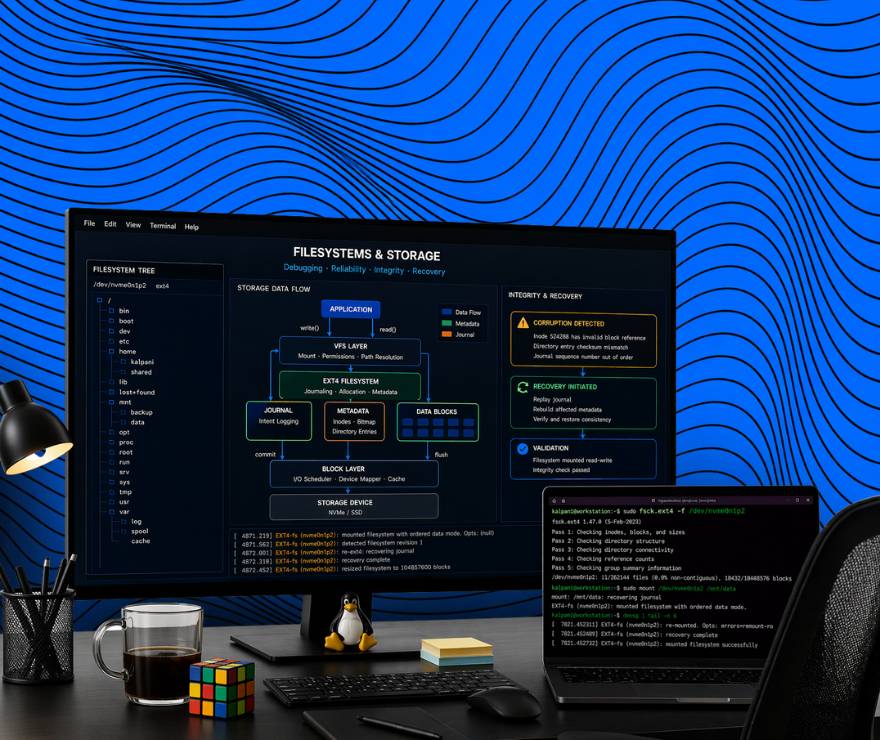
Specialized filesystem and storage engineering services focused on debugging, validating, and optimizing kernel-level data handling across complex storage environments.
Deep debugging and development within filesystem codebases to identify failures, fix inconsistencies, and improve overall filesystem behavior under real workloads.
Investigation of metadata structures to detect corruption paths, validate consistency, and prevent data integrity issues across filesystem operations.
Validation of filesystem lifecycle operations, ensuring correctness during mount, unmount, and recovery scenarios under failure conditions.
Optimization of filesystem operations including read/write paths, caching behavior, and I/O handling to improve efficiency and throughput.
Engineering support across existing and emerging filesystem codebases, ensuring compatibility, stability, and long-term maintainability.
Optimized interaction between filesystem layers and block devices improves reliability across sustained and failure-driven workloads.








Mpiric engineers filesystem and storage systems by focusing on how data integrity is maintained within kernel execution paths. Our work operates directly inside filesystem logic, including metadata handling, journaling, and I/O operations, where even minor inconsistencies can lead to corruption or data loss. By analyzing how filesystems behave under real workloads and failure conditions, we ensure that storage systems remain consistent, predictable, and reliable.
Our approach emphasizes correctness over temporary fixes. As a Linux development company aligned with practices followed across the Linux Foundation ecosystem, we ensure that filesystem changes integrate cleanly, handle edge cases effectively, and remain stable across evolving storage requirements, kernel versions, and system architectures.
Linux filesystem engineering involves working within the kernel to manage how data is stored, retrieved, and validated across storage devices. This includes handling metadata structures, journaling mechanisms, and I/O operations. Engineers focus on ensuring data integrity, debugging filesystem issues, and optimizing storage behavior under real workloads. Unlike user-space storage solutions, kernel-level filesystem engineering directly impacts reliability and correctness.
Filesystem corruption is often caused by improper shutdowns, incomplete writes, hardware failures, or bugs in filesystem logic. Issues in metadata handling, journaling, or concurrency control can also lead to inconsistencies. Identifying the exact cause requires analyzing metadata structures, tracing I/O operations, and reproducing failure scenarios within controlled environments to understand how corruption occurs.
Filesystem debugging involves analyzing kernel logs, tracing execution paths, and inspecting metadata structures to identify inconsistencies. Engineers use tools such as ftrace and crash analysis along with custom instrumentation to observe how filesystem operations behave. This process requires deep understanding of filesystem internals and is critical for resolving complex storage-related issues.
Metadata defines the structure and organization of data within a filesystem, including file locations, permissions, and relationships. Any corruption in metadata can make data inaccessible or lead to inconsistencies. Ensuring metadata integrity is essential for maintaining reliable storage systems, especially in environments where data correctness is critical.
Storage path reliability refers to how consistently data moves through the kernel from the filesystem layer to the underlying hardware. Any instability in this path can result in data loss, corruption, or performance degradation. Ensuring reliability requires analyzing interactions between kernel components and optimizing how data flows through the system.
Validation involves simulating crash scenarios, power failures, and incomplete operations to observe how the filesystem recovers. Engineers test mount, unmount, and recovery processes to ensure data consistency is maintained. This helps identify weaknesses in recovery logic and ensures that the filesystem can handle real-world failure conditions.
Yes, filesystem engineering can improve performance by optimizing read/write paths, caching strategies, and I/O handling. However, performance improvements must be balanced with data integrity to avoid introducing inconsistencies. Kernel-level optimizations ensure that performance gains do not compromise reliability.
Systems such as storage platforms, embedded devices, cloud infrastructure, and databases require advanced filesystem engineering. These environments depend on reliable data handling and consistent storage behavior, making kernel-level expertise essential for maintaining system stability.
Mpiric ensures stability by focusing on correctness, thorough testing, and alignment with upstream kernel practices. Every change is validated under different workloads and failure scenarios to ensure consistent behavior. This approach reduces the risk of future issues and ensures long-term maintainability.
Filesystem engineering requires deep expertise in kernel internals, storage architectures, and data integrity mechanisms. A specialized Linux development company brings the necessary experience to debug complex issues, optimize storage paths, and ensure reliable filesystem behavior in production environments.
Let’s beginHave a question or a project in mind?
Connect with our experts to explore your needs, get tailored solutions, and move your business forward with the right strategy and technology.
127 West 30th Street 9th Floor New York City, NY 10001
12 The Pagoda Maidenhead Berkshire SL6 8EU
+447341216019