A company I spoke with last year burned $480,000 and 14 months building a custom CRM from scratch. Custom fields, custom workflows, custom dashboards. They ended up with a worse version of HubSpot, no mobile app, and one developer who understood the codebase. Another company shoved their entire fulfillment operation into Shopify plus a handful of plugins, then spent two years paying three different contractors to maintain a Frankenstein of Zapier automations. They eventually built a custom order management system in five months. Revenue jumped 34% the next quarter.
That’s the custom software vs off-the-shelf decision in two sentences: get it wrong in either direction, and you bleed money for years.
This guide is the framework CTOs actually use to get it right. We’ll cover real cost ranges, the 5-year total cost of ownership math, the project failure data nobody wants to look at, and a six-question decision framework you can apply this afternoon. By the end, you’ll know exactly when to build custom, when to buy, and when the answer is both. The stakes are high: the custom software development segment alone is growing at a 22.71% CAGR, from $53.02 billion in 2025 to a projected $334.49 billion by 2034, while SaaS spending continues to consume 3545% of total IT budgets in 2026. Getting this decision right shapes your next five years.
Custom Software vs Off-the-Shelf Quick Comparison
| Factor | Off-the-Shelf (COTS/SaaS) | Custom Software |
| Upfront cost | $50$500 per user/month | $20K (MVP) to $2M+ (enterprise) |
| Time to deploy | Days to weeks | 318 months |
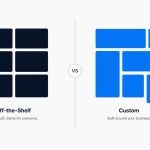
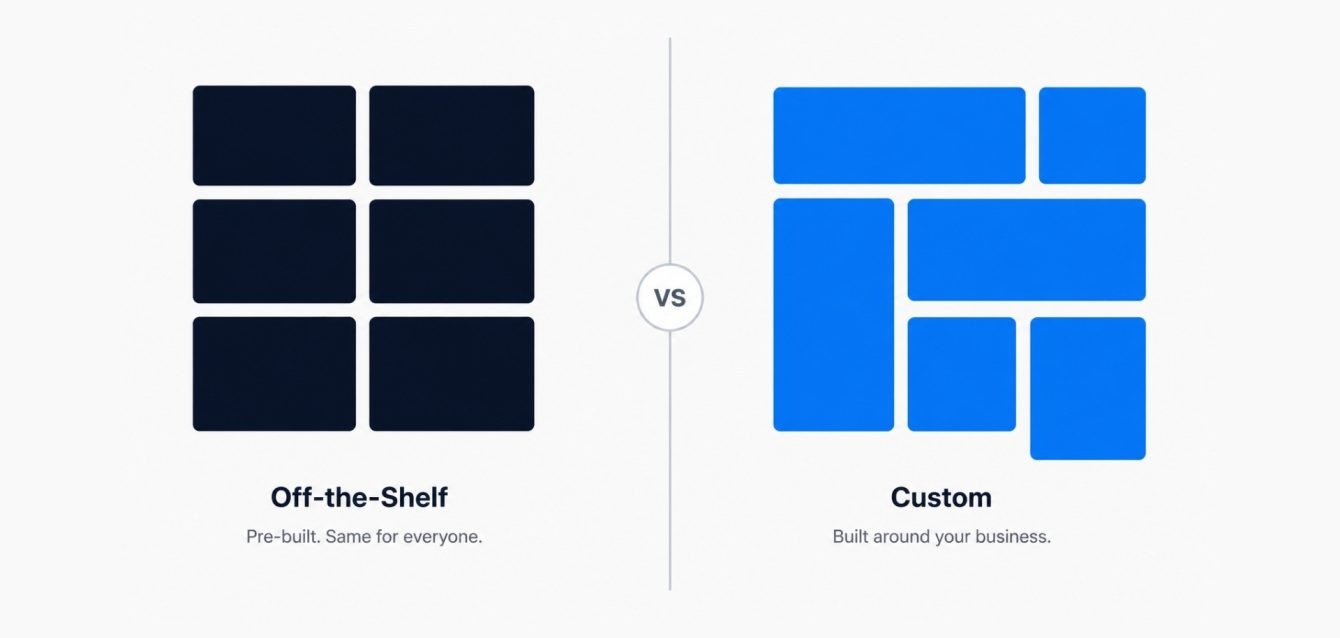
| Process fit | Adapt your business to the tool | Tool fits your business exactly |
| 5-year TCO (mid-market) | Often $500K$1.2M | Often $400K$900K |
| Vendor lock-in | High | None you own the code |
| Price increases | 515% annually | Maintenance ~1520%/year, predictable |
| Best for | Commodity functions, fast validation, limited budgets | Competitive differentiation, complex integrations, long lifecycles |
The honest answer is rarely “one or the other.” It’s a deliberate hybrid and we’ll show you exactly how to draw that line.
What’s Actually at Stake in 2026
The global software market reached $823.92 billion in 2025 and is on track to hit $2.25 trillion by 2034. Gartner projects IT software spending will exceed $6 trillion in 2026. But the most telling data point isn’t about how much businesses spend it’s about how badly it’s distributed.
According to the MuleSoft 2025 Connectivity Benchmark, the average enterprise now runs 897 applications, and only 29% are integrated. That’s not a tooling problem. It’s an architecture problem dressed up as a procurement problem. Every team buys a new SaaS subscription for the immediate pain in front of them, and five years later the CTO inherits a sprawl of disconnected systems, duplicate data, and workflow chaos.
This is the lens to look through when comparing custom software vs off-the-shelf: it’s no longer a binary choice between speed and control. It’s a strategic call about which parts of your business you want to own outright and which parts you’re willing to rent. In the agentic AI era, that distinction gets sharper. AI agents only perform when the context they pull from is coherent. Data scattered across 50 SaaS tools in proprietary formats actively damages your ability to deploy intelligent automation. Bespoke software benefits compound here in ways they didn’t five years ago.
Off-the-Shelf Software: Where It Wins and What It Hides
Off-the-shelf software also called Commercial Off-The-Shelf (COTS) or SaaS refers to pre-built applications you license or subscribe to. Think Salesforce, Microsoft 365, QuickBooks, Shopify, Slack, HubSpot. The vendor builds it, maintains it, updates it. You pay per user, per month, forever.
When off-the-shelf is the right call
For commodity functions accounting, email, internal messaging, ticketing, payroll, basic CRM, time tracking there’s no upside to building custom. A vendor has spent a decade perfecting QuickBooks. You won’t beat it. You won’t even tie it. Buying is correct.
The same logic applies when:
- You need a working solution this quarter, not next year
- The function is genuinely standard across your industry
- Your processes can adapt to the software’s workflows without losing meaningful efficiency
- Your budget is under $30,000 and your team can’t support custom development
For early-stage startups, “buy everything” is usually the right default. You don’t yet know which workflows will become your differentiation. Validate first, build later.
The hidden costs nobody quotes
Off-the-shelf software’s price tag is the floor, not the ceiling. The real costs accumulate in places vendors don’t advertise:
1. Integration tax.
Connecting off-the-shelf platforms to your other systems typically costs $20,000 to $100,000 per integration, sometimes more for legacy systems. When you run 897 apps, this becomes a permanent line item.
2. Per-user price creep.
A $15-per-user-per-month tool sounds cheap until you have 2,000 users. That’s $360,000 per year. SaaS vendors raise prices 5% to 15% annually, and there’s nothing you can do about it.
3. The customization-beyond-recognition trap.
Companies routinely spend $200,000+ customizing Salesforce or SAP to fit their workflows. At that point you’ve spent custom-software money without getting any of the benefits you still pay licensing, you still don’t own the code, and your customizations break with every vendor upgrade.
4. Vendor lock-in.
Your data lives in their format. Migration is a 6-to-12 month nightmare for any non-trivial system. The vendor knows this, which is why prices go up.
5. The “future roadmap” problem.
The features you need most are always “on the roadmap.” Sometimes they ship. Sometimes the vendor pivots. Either way, you’re not in control.
A good rule of thumb: if your annual SaaS spend for a single tool exceeds 30% of what a custom replacement would cost over three years, you’re in build-territory.
Custom Software: The Real Bespoke Software Benefits
Custom (or bespoke) software is built specifically for your organization. The architecture, features, integrations, and data model are all designed around how your business actually works not how a vendor’s mass-market product imagines your business works.
The bespoke software benefits that matter most in 2026:
1. Perfect process fit.
The software adapts to your workflows instead of forcing you to adapt to it. For companies whose operational efficiency is the competitive advantage think specialty manufacturers, vertical e-commerce, regulated industries this is the entire game.
2. Competitive differentiation.
You can’t buy a competitive advantage off a shelf that your competitors have access to. If three of your competitors run the same Salesforce instance, none of you can win on operational software. Custom software is one of the few ways to build a moat in a category where everyone has access to the same SaaS tools.
3. Full ownership of source code, data, and roadmap.
No vendor decides what features you get next. No vendor decides when prices go up. No vendor decides to deprecate the API you depend on.
4. AI/agentic readiness.
Off-the-shelf platforms lock your data in proprietary formats designed to feed their AI features, not yours. Custom software lets you architect your data layer for the AI strategy you actually want to deploy proprietary models, fine-tuned LLMs, autonomous workflow agents.
5. Predictable economics at scale.
Per-user licensing scales linearly with headcount. Custom software scales with usage, which usually means infrastructure cost far cheaper. The TCO crossover typically happens between user 200 and user 500, depending on the vendor.
6. Compliance and data sovereignty.
Healthcare (HIPAA), finance (PCI-DSS, SOX), government (FedRAMP), EU operations (GDPR) for regulated industries, custom software often isn’t optional. The audit trail, data residency, and access controls you need can’t be retrofitted onto a generic SaaS tool.
The realistic flip side: building custom software isn’t easy, isn’t fast, and isn’t always cheap. It requires discovery, design, engineering, QA, deployment, and ongoing maintenance. Done right, the ROI typically arrives in years 34 and compounds from there. Done wrong, you get the $480K-CRM-disaster. The difference is execution which is why partner selection matters as much as the build-vs-buy decision itself. For enterprises evaluating long-term software bets, working with a partner that delivers enterprise software solutions end-to-end tends to be the deciding factor between the two outcomes.
The Real Cost Comparison: 5-Year TCO Math
Sticker price is the worst possible way to make this decision. Total Cost of Ownership over five years is the right way. Here’s the math that actually matters.
Off-the-shelf 5-year TCO formula
5-yr OTS TCO = (Monthly cost × users × 60)
+ integration costs
+ customization costs
+ workaround/manual-process costs
+ 5-15% annual price increases
Custom 5-year TCO formula
5-yr Custom TCO = Build cost × 1.5 (always overshoots initial estimate)
+ (maintenance at 1520% of build × 5 years)
+ infrastructure & hosting
+ ongoing feature development
Worked example: E-commerce company evaluating order management
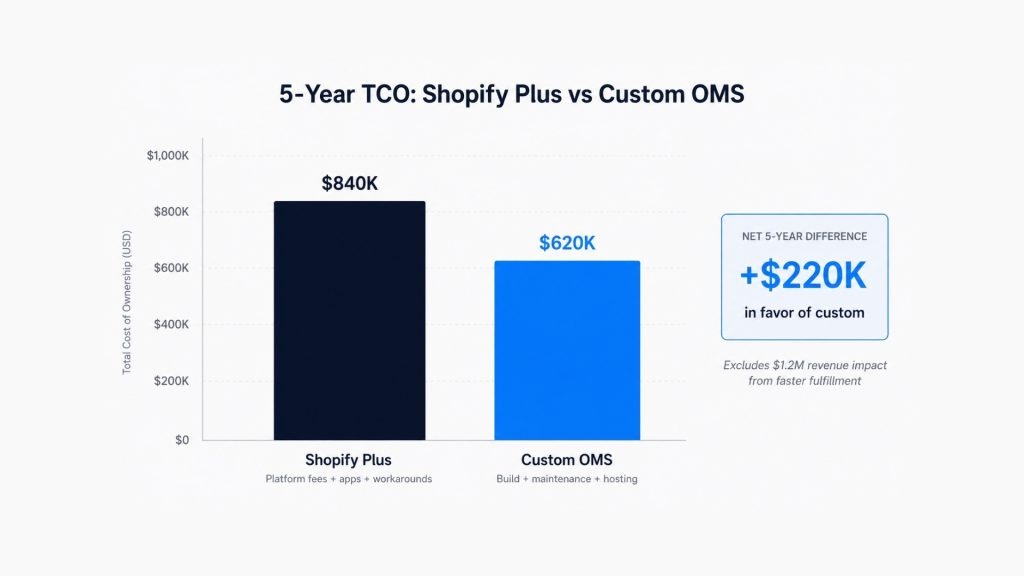
A 150-employee e-commerce business processing 8,000 orders per day was evaluating Shopify Plus versus a custom Order Management System (OMS):
Shopify Plus 5-year TCO: ~$840,000
- Platform fees: $2,000/month base + 0.15% transaction fees
- 14 supporting app subscriptions: $4,200/month
- 3 custom Zapier-based integration contractors: $180,000/year
- Lost revenue from order errors and slow fulfillment: estimated $90,000/year
- Annual SaaS price increases: ~9% compounded
Custom OMS 5-year TCO: ~$620,000
- Initial build: $280,000 over 7 months
- Maintenance at 18%/year: $50,400/year
- Cloud hosting and infrastructure: $24,000/year
- Two additional feature releases per year: $80,000 total
Net 5-year TCO difference: $220,000 in favor of custom.
But that’s only half the story. The custom OMS reduced fulfillment errors by 73% and dropped average order-to-ship time from 28 hours to 6 hours. Conservative estimate of revenue impact: $1.2 million in retained customers and reduced refunds over five years. The actual ROI difference is closer to $1.4 million.
This is where most build-vs-buy analyses go wrong. They compare cost-against-cost when they should compare cost-against-value. For SaaS-stage companies hitting this exact crossover, evaluating dedicated SaaS product development is often the moment the TCO math flips.
Realistic 2026 cost ranges for custom builds
| Project type | Range | Typical timeline |
| MVP / Single workflow tool | $20,000 $75,000 | 24 months |
| Mid-market platform (CRM, OMS, internal portal) | $75,000 $250,000 | 59 months |
| Enterprise system (ERP, multi-tenant SaaS) | $400,000 $2,000,000 | 1018 months |
| Complex regulated platform (fintech, healthtech) | $500,000 $5,000,000+ | 1224 months |
Maintenance: budget 1520% of initial build cost annually for ongoing development, bug fixes, security patches, and infrastructure.
The Failure Rate Reality
Now the part of the conversation most articles skip: building custom software is risky.
The Standish Group’s CHAOS 2020 report the most cited research in the field found that only 31% of software projects succeed. Another 50% are “challenged” (over budget, late, or short on features), and 19% fail outright. Large projects do far worse: success rates drop below 10% for projects exceeding $15 million.
McKinsey and the University of Oxford studied large IT projects together and found they run, on average, 45% over budget, 7% over time, and deliver 56% less value than predicted. McKinsey’s 2020 research found that 17% of large IT projects go so badly they threaten the very existence of the company. One in six has a 200% cost overrun.
This isn’t an argument against custom software. It’s an argument against custom software done poorly. The Standish data is clear about the cause: 39% of failures trace to poor requirements gathering, 57% involve communication breakdowns, and the rest split between scope creep, weak execution, and inadequate testing.
The implication for the custom software vs off-the-shelf decision: choosing to build custom is also a commitment to running the project with discipline. If your organization has never successfully delivered a six-figure software project, hiring a vendor to build you a $400K platform with no internal product owner is the riskiest possible move. Off-the-shelf even with all its flaws is the safer call until you build that execution muscle.
The companies that succeed with custom software have three things in common: a clear product owner with decision authority, a discovery phase that’s at least 10% of the total budget, and a delivery partner with a track record in their domain.
The CTO’s 6-Question Decision Framework
Walk every build-vs-buy decision through these six questions in order. The first three are about strategic fit. The next three are about feasibility. Skip any of them at your own cost.
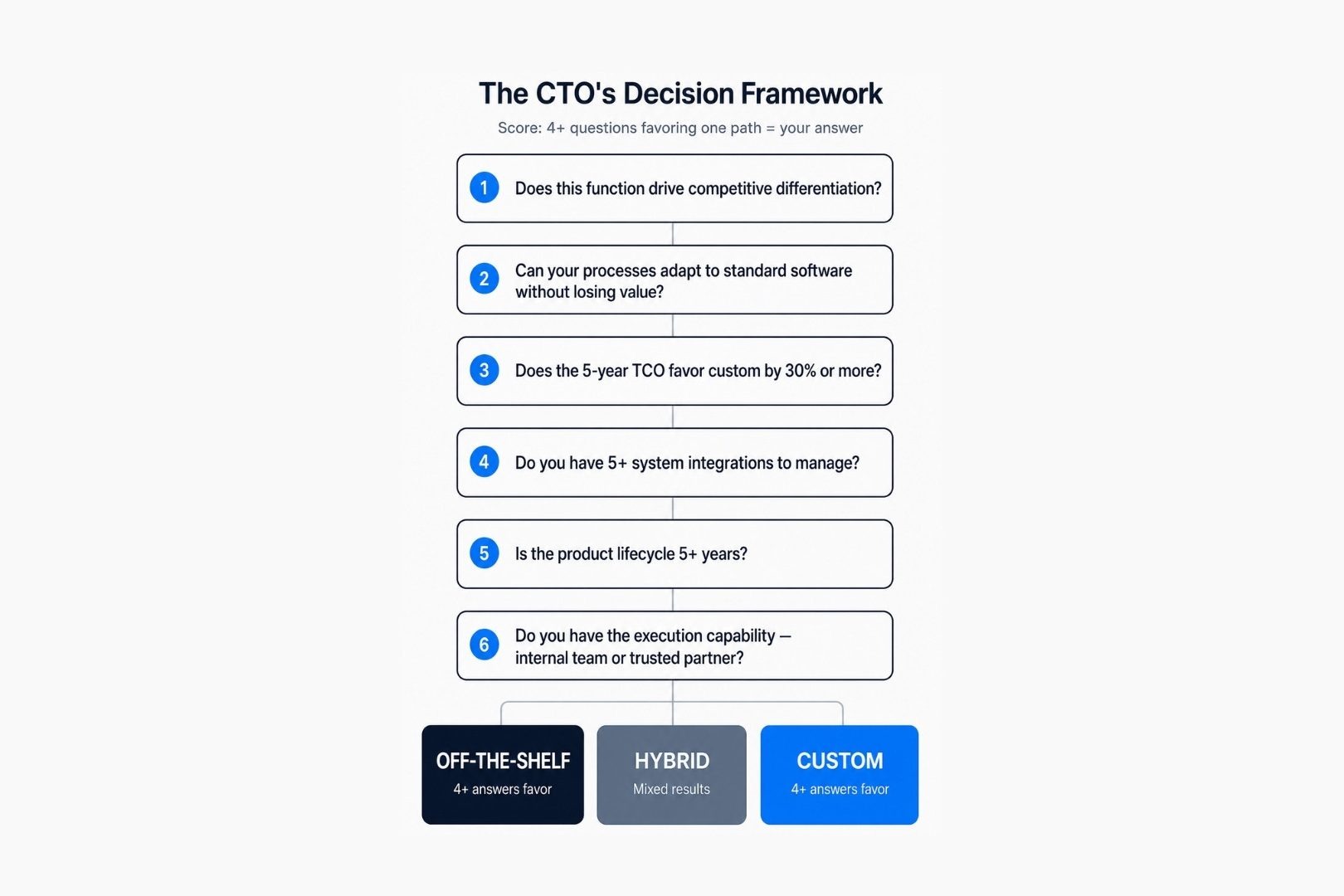
Question 1: Does this function drive competitive differentiation?
If the answer is yes if how you do this thing is part of why customers choose you lean custom. If it’s commodity work that every business in your industry does the same way, buy.
Examples: a custom pricing engine for an insurance company is differentiation. The accounting system used to book the resulting revenue is commodity. Build the first, buy the second.
Question 2: Can your processes adapt to standard software without losing value?
If your workflows can fit a SaaS platform’s defaults with minor adjustment, OTS works. If adopting standard software means abandoning a workflow that’s been refined over years and genuinely makes you better, custom is the call.
Test: ask the team that uses the current process whether the proposed SaaS workflow makes them faster or slower. If they consistently say slower, that’s your answer.
Question 3: What’s the 5-year TCO for each option with real numbers, not vendor pricing?
Run both formulas above. Include integration costs, customization, workarounds, and the cost of inefficiency. Then add a 1.5x multiplier to whatever the vendor or internal team quotes for custom (because both always under-estimate).
If the 5-year TCO favors custom by less than 20%, default to OTS execution risk eats the difference. If it favors custom by 30%+, custom is likely the right call.
Question 4: How complex is your integration burden?
If the custom solution would need to connect to 5+ existing systems with non-trivial data flow between them, weigh integration heavily. Custom software designed with your integrations in mind is usually cheaper to maintain than 20 brittle Zapier flows connecting six SaaS tools.
Question 5: What’s the product lifecycle 3 years or 10?
If you’re solving a problem that will look completely different in three years, buy. The custom build won’t pay back its TCO. If you’re building infrastructure your business will run on for a decade, the math flips fast custom amortizes over time, while SaaS keeps charging.
Question 6: Do you have the execution capability?
Internally or via a trusted partner. This is the question that kills most custom software projects when answered honestly. Custom development needs a clear product owner, a discovery phase, a competent engineering team, real QA, and a maintenance plan. If you can’t honestly check all five boxes, fix that first or stay with off-the-shelf until you can.
Scoring: If 4 or more questions favor custom, build. If 4 or more favor off-the-shelf, buy. Mixed results almost always point to a hybrid model.
The Hybrid Model: What Smart CTOs Actually Do in 2026
The build-vs-buy framing is a false binary. Gartner calls the modern approach composable architecture: SaaS for commodity functions, custom for differentiation, and a custom integration layer connecting both.
This is what a typical hybrid stack looks like for a mid-market business in 2026:
- Off-the-shelf, commodity: Email (Google Workspace), accounting (QuickBooks or NetSuite), HR (Rippling or Gusto), payroll, internal messaging (Slack), document signing (DocuSign)
- Off-the-shelf, supported: CRM (Salesforce or HubSpot), customer support (Zendesk or Intercom), analytics (Mixpanel, Amplitude)
- Custom, differentiation: Core operational platform (proprietary OMS, pricing engine, scheduling logic, customer-facing portal), proprietary data layer, AI/ML pipelines
- Custom integration middleware: APIs, event buses, ETL pipelines, identity orchestration the glue that makes the other two layers behave as one system
The integration layer is the part most teams underestimate. Connecting Salesforce to a custom OMS to an off-the-shelf billing platform to your warehouse system requires real engineering, not no-code automation. Robust API development and integration work is what makes the composable model deliver on its promise instead of becoming the new Frankenstein.
Done well, the hybrid model gives you the speed of SaaS for commodity needs, the differentiation of custom for what matters, and the data coherence that makes the whole stack AI-ready.
Industry-Specific Guidance
Different industries have different default answers to the custom software vs off-the-shelf question. Here’s where each tends to land:
Manufacturing
Manufacturing operations live or die on ERP fit. The off-the-shelf giants SAP, Oracle, Microsoft Dynamics handle 70% of common workflows well, but the remaining 30% (production scheduling, machine integration, custom quality workflows, supplier-specific portals) is where every manufacturer loses or wins. Custom ERP modules or fully custom platforms tend to deliver 35x ROI over forced-fit OTS. For most manufacturers, the right path is a hybrid: standard ERP core plus custom modules built around it. Partners offering full ERP development typically deliver this hybrid faster than trying to fork a generic platform.
SaaS startups and product companies
Default to no-code and OTS for the first 612 months while you validate the market. Bubble, Webflow, Retool, and Airtable have taken many companies to $100K$1M ARR before they wrote a line of custom code. Use that revenue to fund the eventual custom build. The right time to graduate to custom is when no-code starts breaking usually around the point you need real-time logic, multi-tenant security, or scale beyond a few hundred users. A well-scoped MVP development engagement at that crossover point is often the lowest-risk path forward.
Fintech and healthcare
Regulated industries usually need custom from day one. HIPAA, SOC 2, PCI-DSS, SOX, GDPR, and 23 NYCRR 500 don’t bend around SaaS limitations. Even when the vendor is technically compliant, the audit trail, data residency, and access control granularity required for serious regulated workloads almost always exceed what OTS provides. Build custom for any system that touches PHI, PII, or financial transactions.
E-commerce
Shopify and similar platforms handle the standard storefront for the first $10M of revenue beautifully. Beyond that or earlier if you have unusual fulfillment, B2B pricing, complex catalogs, or multi-channel needs custom or hybrid wins. The Shopify Plus vs custom OMS example earlier in this article is the most common crossover point.
Small and mid-sized businesses (under 100 employees)
Default to OTS. Custom software at this scale rarely pays back unless the company has one specific workflow that’s central to its competitive position. If you find that workflow, build custom only for that one thing and buy everything else.
Common Mistakes That Tank Custom Projects
If you decide to build custom, these are the mistakes that turn $300K projects into $700K projects. They’re documented in Standish’s data and confirmed by every engineering team that’s lived through them.
Skipping or under-funding discovery. Discovery should be 510% of total project budget. Teams that skip it to “save money” routinely overshoot by 50100% because they’re designing as they build.
Letting developers make the build-vs-buy decision. Developers want to build things. It’s their craft. The question “should we build this?” has to come from product or executive leadership, not the team that benefits from saying yes.
Choosing vendors on hourly rate alone. A $25/hour offshore team and a $90/hour senior team are not interchangeable. Communication overhead, rework, and quality issues consistently make the cheaper option more expensive. Look at delivery track record, not rate cards.
Treating QA as a phase, not a practice. Software that ships with hidden bugs costs 610x more to fix in production than in development. Building QA testing and performance optimization into the engineering process from day one not bolted on at the end is the single biggest predictor of whether a custom project hits its delivery date. Treating QA testing and performance optimization as a continuous discipline, not a checkbox at the end, separates the projects that ship from the projects that limp.
No internal product owner. If your CTO is the only person from the client side talking to the dev team, the project is structurally fragile. There needs to be someone whose full-time job is owning the product, prioritizing the backlog, and saying no to scope creep.
Underestimating maintenance. Custom software needs ongoing investment. Budget 1520% of build cost annually, and treat that as non-negotiable. The companies that ship and then walk away end up with brittle systems that fail spectacularly two years later.
Frequently Asked Questions
What is the difference between custom and off-the-shelf software? Off-the-shelf software is a pre-built product designed for a broad market Salesforce, QuickBooks, Shopify. You adapt your workflows to fit it. Custom software is built from scratch around your specific business processes and requirements. You own the code, the roadmap, and the data.
Is custom software always more expensive than off-the-shelf? In upfront cost, yes custom starts at $20K+, while OTS often starts at $50/user/month. Over 5 years, custom is frequently cheaper for organizations with 200+ users or unique processes, because OTS per-user pricing scales linearly while custom maintenance stays flat.
How long does it take to build custom software? MVP / single workflow tool: 24 months. Mid-market platform: 59 months. Enterprise system: 1018 months. Complex regulated platforms: 1224 months.
When should a company build custom software? When the function drives competitive differentiation, when processes can’t adapt to standard tools without losing value, when 5-year TCO favors custom by 30%+, when integration complexity is high, when the product has a 5+ year lifecycle, and when you have the execution capability internally or via a partner.
What are the biggest bespoke software benefits? Perfect process fit, competitive differentiation, full ownership of code and data, AI/agentic readiness, predictable scaling economics, and compliance flexibility for regulated industries.
Can off-the-shelf software be customized? Yes, but with limits. Light customization (workflows, fields, dashboards) is usually fine. Deep customization spending $200K+ to bend Salesforce around your workflow is “the worst of both worlds.” You pay custom-software money without getting any of the ownership benefits, and your customizations break at every vendor upgrade.
What is hybrid software architecture? A deliberate mix: off-the-shelf platforms for commodity functions (email, accounting, basic CRM), custom software for competitive differentiation (proprietary workflows, customer-facing products, AI/data layers), and custom integration middleware (APIs, event buses) connecting both. Gartner calls this composable architecture; it’s the dominant pattern for mid-market and enterprise CTOs in 2026.
What’s the failure rate for custom software projects? Standish CHAOS 2020 data: 31% succeed, 50% are challenged, 19% fail outright. Large projects fare worse. Most failures trace to poor requirements (39%), communication breakdowns (57%), and weak QA. Choosing a partner with strong delivery discipline is the single biggest predictor of success.
Conclusion
The custom software vs off-the-shelf decision isn’t about which approach is better it’s about which approach fits this specific function for this specific business over the next five years. Off-the-shelf wins for commodity work, fast validation, and tight budgets. Bespoke software benefits dominate when the function drives competitive advantage, when integration complexity is real, or when the product lifecycle stretches beyond three years. For most mature businesses in 2026, the right answer is a deliberate hybrid: SaaS for the commodities, custom for the differentiators, and serious integration engineering tying it all together.
If you’re at this crossroads weighing a build, scoping a hybrid, or trying to escape a Frankenstein SaaS stack the next step is a structured discovery conversation, not a sales pitch. Mpiric Software builds custom platforms, integrates hybrid stacks, and runs honest TCO assessments to tell you when not to build. That’s usually how the right decision gets made.